What Happens to Your Business Data When You Connect AI to Google Workspace?
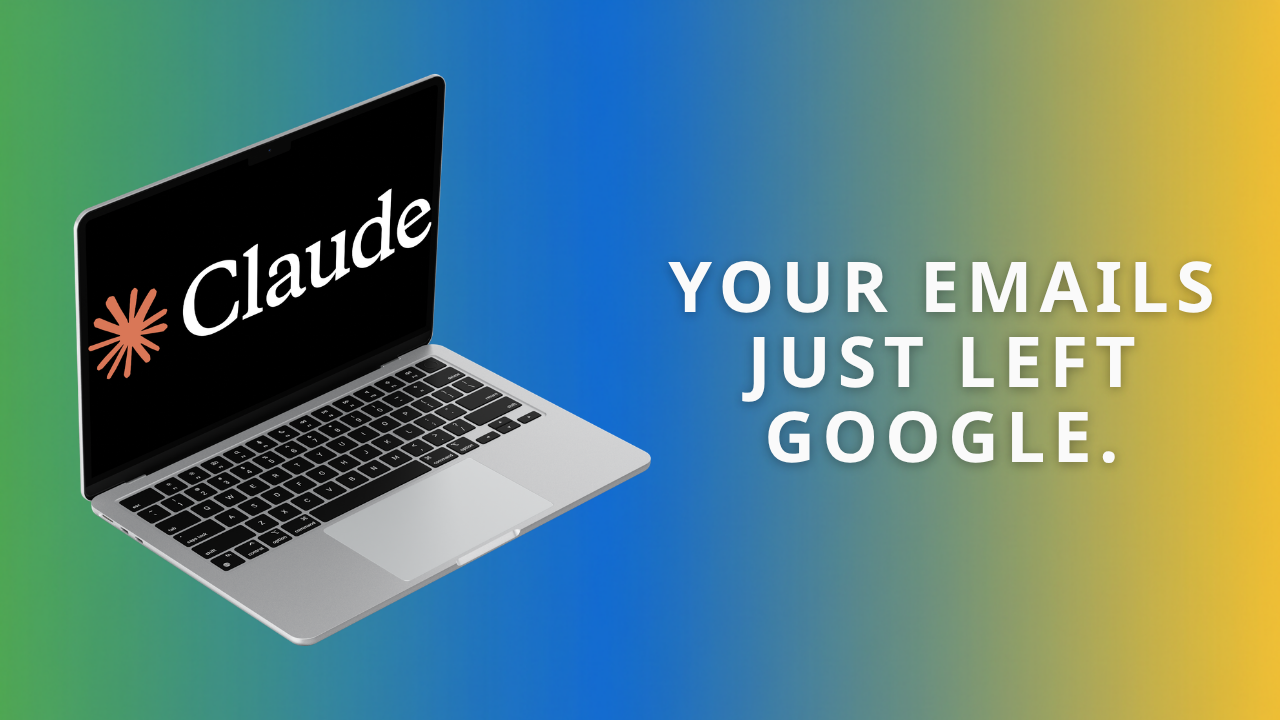
When you connect an AI tool like Claude to your Google Workspace account, your data leaves Google's servers and gets copied to the AI provider's servers. That's not speculation — it's confirmed in Anthropic's own documentation. Most people setting up the integration have no idea this is happening.
What actually happens when you connect Claude to your Gmail?
Connecting Claude to Gmail, Calendar, or Drive feels like a natural extension of your existing tools. You're already in Google. Claude just reads what's there. Convenient, right?
Here's what actually happens. The moment Claude retrieves an email, a meeting, or a document to answer your question, that content gets copied to Anthropic's servers. You have now moved business data out of an environment your IT provider controls and into one they have no visibility over.
Anthropic's own support documentation confirms this directly: "Data retrieved while using connectors is stored on Anthropic servers."
How long does your data stay there?
Your data stays on Anthropic's servers for as long as the chat exists. Delete the chat and the data goes with it — but only if you remember to delete it, and only if you realise what was pulled in.
There is no automatic expiry. No retention policy you can configure. No admin console where you can see which emails were accessed, by whom, and when. If someone on your team connects their Gmail, asks Claude a few questions, and forgets about it, that data sits there indefinitely.
Compare that to your Google Workspace by Kimbley IT environment, where your IT support provider can set retention policies, pull audit logs, and see exactly what's been accessed. You have governance. With an AI connector, you don't.
What about training data?
This is where things get more uncomfortable — and it depends on your plan.
Anthropic's documentation is clear that connector data is not used for model training by default. But there's a catch. On Free, Pro, and Max plans, if a team member has opted in to allowing their chats to be used for training — which became the default opt-in for consumer accounts as of October 2025 — then content from their Gmail and Calendar that appears in Claude's responses can contribute to model training.
So if someone on your team is on a personal Claude Pro account and has that setting enabled, the business emails Claude retrieves and references could, in theory, end up in Anthropic's training data. That means your client correspondence could contribute to improving a public AI model.
This doesn't apply to Team or Enterprise plans, where training on your data is off by default and there are stronger admin controls. But if your team is using personal accounts — which many small businesses are — it's worth checking.
Does Google's Advanced Protection Programme help?
No. And it's worth explaining why, because this comes up a lot.
Google's Advanced Protection Programme controls which apps can connect to your Google account in the first place. It's a gatekeeper at the door. Once an app has been granted access and is through that door, the programme has zero say over what happens to your data afterwards.
Even if Claude were Advanced Protection-verified, the data storage situation would be identical. Your emails would still leave Google's servers and land on Anthropic's. APP protects the connection, not the destination.
Is this just a Claude problem?
No. This applies to any AI tool that connects to your Google Workspace from outside it.
| AI Tool | What happens to your data | Stays in Google? |
|---|---|---|
| AI tools and your Google Workspace data | ||
| Claude |
When Claude retrieves an email, meeting, or document, that content is copied to Anthropic's servers. It stays there for the life of the chat with no automatic expiry.
|
External servers |
| ChatGPT |
Connecting ChatGPT to Google Workspace via plugins moves retrieved data to OpenAI's servers. The same governance gap applies — no retention policies, no audit trail.
|
External servers |
| Gemini for Workspace |
Gemini is built directly into Google Workspace. There is no connector, no third-party transfer, and no separate data environment. Your data stays exactly where it already lives.
|
Stays in Google |
The standout here is Gemini. Because it's built directly into Google Workspace, your data never leaves Google's servers at all. There's no transfer to a third party, no separate privacy policy to worry about, and no new data environment to govern.
If you're a Kimbley IT client, you're on Google Workspace by Kimbley IT — which includes Business Plus — so you already have access to Gemini. For many everyday tasks, it's the sensible first choice precisely because it keeps your data where it already lives. If you're not sure which Gemini model to use for different tasks, we've covered that in a separate guide, and if you're wondering whether you need to pay extra for it, the short answer is probably not.
What's the practical approach?
Keep connectors disconnected until you genuinely need them — and when you do use an AI tool, share only what's necessary for that specific task.
Instead of granting Claude access to your entire Gmail inbox, copy and paste the relevant email into the chat. Instead of connecting Drive, upload the specific document you want it to analyse. You make a conscious decision each time about what leaves your Google environment, rather than giving blanket access and hoping for the best.
This isn't about avoiding AI tools. They're genuinely useful. It's about using them with the same judgment you'd apply to any other tool that handles business data. We've written before about why approved AI access matters for your business — the same principle applies here.
Frequently asked questions
If I delete my Claude chat, is the data gone? Yes — deleting the chat removes the associated connector data from Anthropic's servers. The issue is remembering to do it and knowing what was accessed in the first place.
Are Team and Enterprise Claude plans safer? More so, yes. Training on your data is off by default; there are stronger admin controls, and owners can disable connectors entirely. But data still moves to Anthropic's servers when connectors are used — that part doesn't change.
What's the safest way to use AI with business data? Manually share only the specific information you're comfortable with for each task. Avoid granting persistent access to your inbox, calendar, or Drive unless you've spoken to your IT provider and understood the implications.
Does Kimbley IT recommend using AI connectors? We recommend understanding what they do before enabling them. For some businesses and use cases, the productivity benefit is worth the trade-off. For others — particularly those handling client-confidential data — the risks outweigh the convenience.
Not sure if your team's AI tools are putting your data at risk?
If this post has made you think twice about how your team uses AI tools, that instinct is worth acting on. Every day those connectors stay enabled is another day your business data is sitting somewhere you can't see, audit, or control.
Book a free 15-minute video call with Kimbley IT. We'll look at what AI tools your team is using, where your data is going, and what — if anything — needs to change. No jargon, no sales pitch, just a straight conversation.